
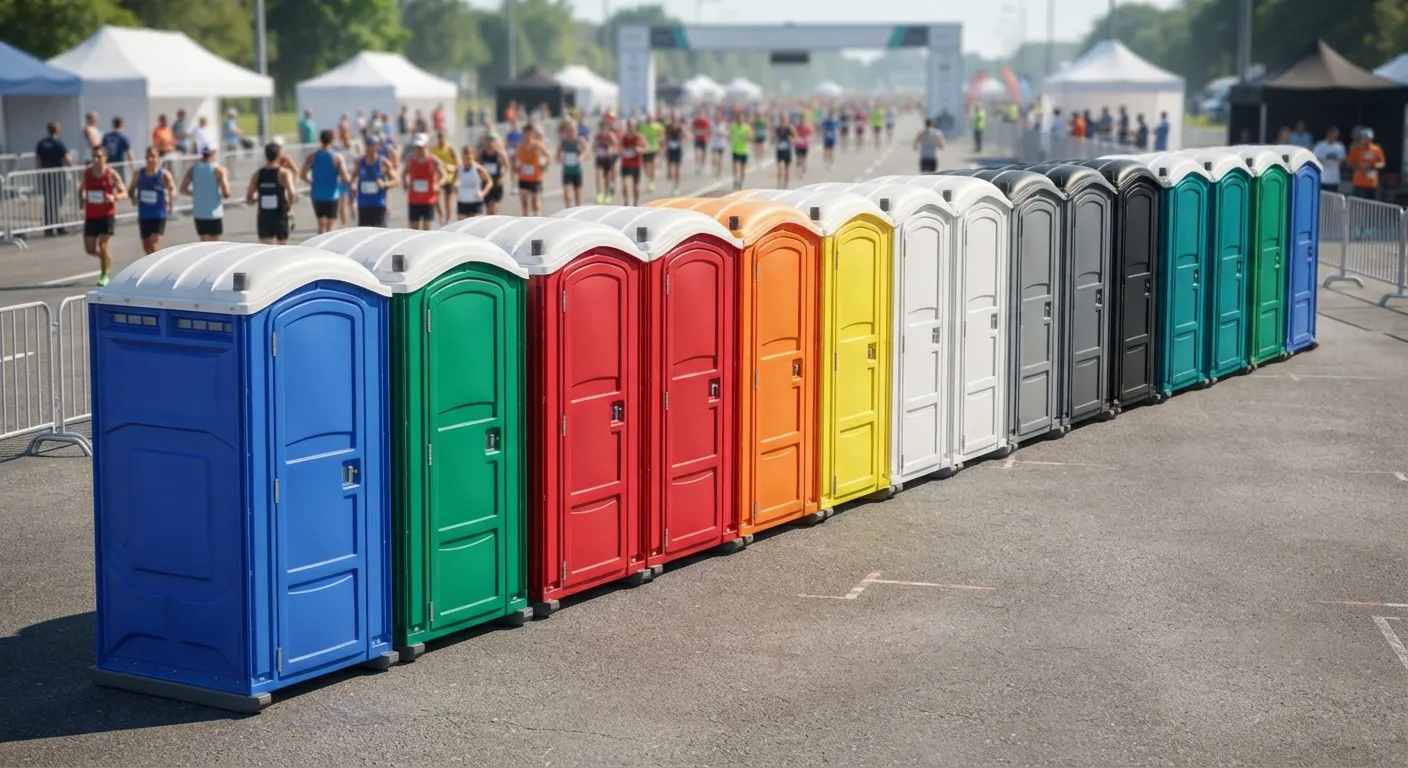
How many restrooms does a marathon need?
There's no single number, but OSHA 1926.51(c) gives the baseline math event planners lean on: one toilet per 20 people for smaller crowds, scaling up from there. A 5K with 300 runners looks different than a full marathon with 3,000, so start with our guide on how many porta potties you need before you call anyone. Race organizers in Pembroke Pines typically place clusters at the start line, then again near mile 6 or 7, then a heavier bank at the finish where runners linger. If your course crosses into Cooper City, 6.7 miles northeast, or loops toward Southwest Ranches, 8.0 miles northwest, you'll want restroom clusters at each jurisdiction crossing, not just the endpoints. ADA Standards section 213.2 requires that at least 5 percent of a cluster be accessible units, never fewer than one, so if you're setting ten standard units at a water stop, one of those needs to be an ADA accessible porta potty. Spacing matters too. A unit dropped where a delivery truck can't get within 60 feet of straight clearance is a unit that shows up late or not at all, so scout your drop zones before race week, especially at finish lines packed with barricades and vendor tents. For events layering in a VIP or hospitality tent, a deluxe flushable porta potty reads better than a standard unit lined up next to catering.
What else does a race site need besides toilets?
Timing tents, medical stations and finish-line staging all draw power, and that's where planning gets overlooked until the morning of. If you're running a generator or a temp power connection for a results board or PA system, know how to brace a temporary power pole before the crew shows up, not after it's already leaning. A pole that isn't braced against wind or a stray elbow from the crowd is a hazard, and OSHA 1926.404(b)(1)(ii) covers the ground fault protection that has to be in place wherever that power feeds anything near water or wet ground, which a race course full of sweating runners and hydration stations absolutely is. Beyond power, most races need handwashing near food and hydration tables. A handwashing station rental or a simple portable sink rental covers that, and 29 CFR 1910.141(d)(2) is clear that soap and towels have to be part of the setup, not hand sanitizer standing in for it. Crowd control barricades matter at the start and finish, where OSHA 1926.202 calls for barricades that meet ANSI D6.1, so don't just borrow orange cones from a construction site. If your race route needs the corral area fenced for staging or a secure zone for bag check, look at temporary fence rental or crowd control barrier rental rather than improvising with folding tables. Trash and recycling along the course adds up fast too, and a roll-off dumpster rental staged near the finish keeps volunteers from hauling bags across the lot all afternoon.

Should I rent by the day or the week for a race weekend?
Most Pembroke Pines races run Friday setup through Sunday teardown, so a weekend rate on standard units, generally $125 to $400 depending on count and add-ons, usually beats booking single days separately. Bigger multi-day festivals or stage races sometimes make more sense on a full week rental instead. Here's how the math typically breaks down:
| Rental length | Standard unit price | Best for |
|---|---|---|
| Day | $100 to $350 | Single-day fun runs, packet pickup only |
| Weekend | $125 to $400 | Friday setup through Sunday race |
| Week | $130 to $500 | Multi-day festivals, stage races |
| Month | $125 to $325 | Training season, recurring events |
If your race includes a VIP tent or a media area, a restroom trailer rental or a smaller 2 stall restroom trailer gives sponsors and staff something nicer than a standard line of units. For big city races with thousands of finishers, an 8 stall restroom trailer at the finish line cuts the line dramatically compared to single units. Whatever you choose, check our porta potty rental cost page and porta potty rental per day breakdown so your budget lines up with actual Pembroke Pines pricing, not a national average. Races staged near Plantation, 15.6 miles northeast, or reaching toward Miami Lakes, 12.1 miles south, should also check our service areas page to confirm delivery zones before locking a route map.
How far in advance should I book restrooms for a race?
Two to three weeks out is comfortable for most Pembroke Pines races. Larger events with multiple restroom clusters, trailers or fencing should book a month ahead, since delivery trucks need clear routing and staging time before race morning.
Do I need ADA accessible units at a race?
Yes. ADA Standards section 213.2 requires at least one accessible unit per cluster, minimum 5 percent of the total. Place these near the start and finish where mobility-limited spectators and runners actually need them, not off to one side.
Can porta potties be moved mid-course after delivery?
Generally no, once trucks are gone for the morning. Plan your mile-marker and water-stop locations in advance using our placement guide so everything's set before the gun goes off.
What if my race gets rained out or postponed?
Call your provider immediately. Units already delivered often can stay in place for a rescheduled date depending on availability; ask about emergency porta potty rental if you need same-week replacements or moved timing.
Do finish-line restrooms need more units than the start line?
Usually yes. Runners cluster and linger at the finish far longer than at the start corral, so weight your restroom count heavier there, along with any handwashing station rental near food or medical tents.
Next step
Get a delivery date
Tell us the address, the dates and the headcount. We size the order and confirm the route.